
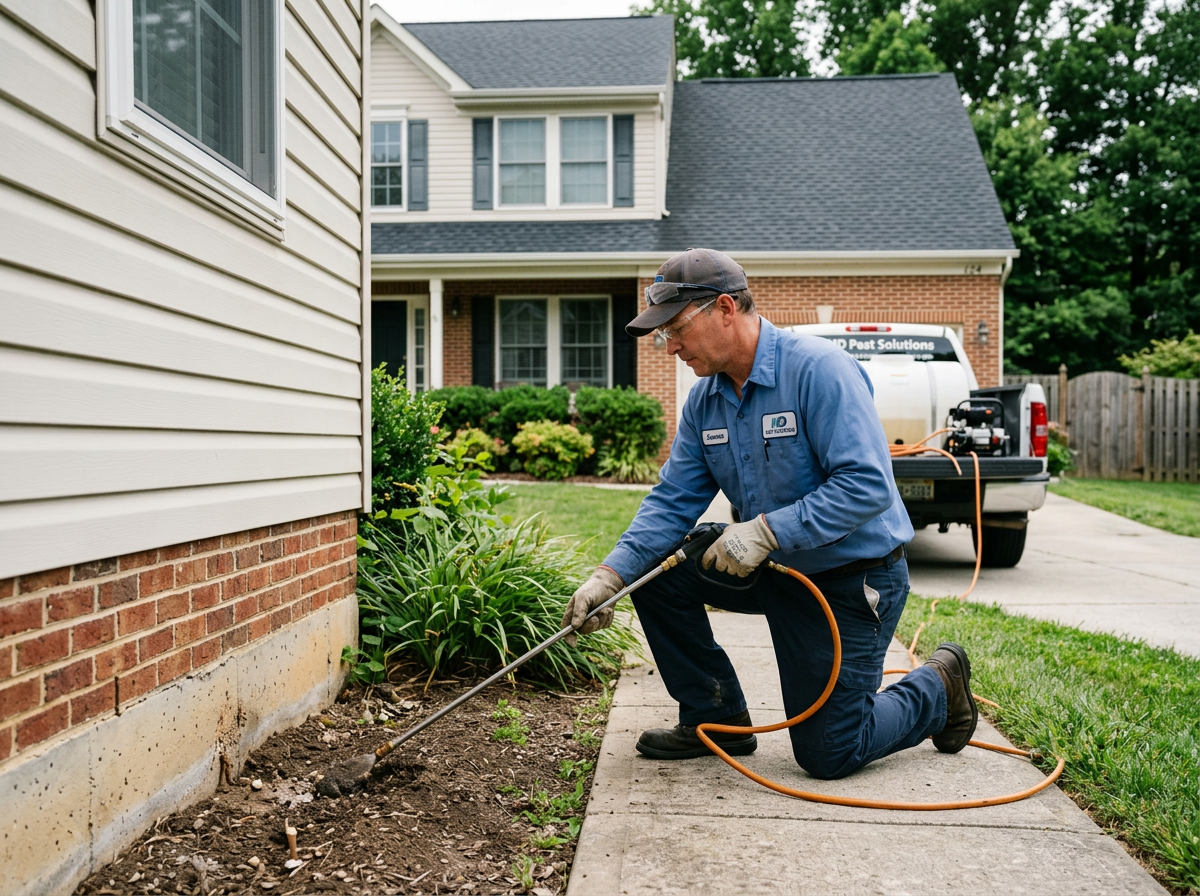
Eastern subterranean termites dominate Maryland properties, especially on the Eastern Shore where high water tables and pier-supported homes create constant wood-to-soil contact. Technicians identify active colonies through mud tubes along foundation walls, piers, and joists rather than relying on swarmers alone, which homeowners often mistake for flying ants. A proper treatment establishes an unbroken chemical zone in the soil around and under the structure so foraging workers cannot reach the wood above. Gaps left near additions, utility entries, or previous repairs allow the colony to bypass the barrier and re-enter within months.
Liquid soil barrier work begins with trenching along the exterior perimeter and rodding under slabs and porches to place termiticide at label depth. In crawl spaces, treatment extends to piers, sill plates, and any grade beams where soil contact occurs. Bait stations offer an alternative when excavation would disturb landscaping or when the structure sits too close to wells or drainage features. Neither method reaches every forager instantly because the colony may extend sixty feet or more from the visible tubes, so follow-up inspections confirm whether activity has ceased or shifted to untreated soil.
Termite Treatment Near You — Choose Your City
Every city below has its own local Termite Treatment page with coverage details.
St. Mary's County
Somerset County
Wicomico County
Talbot County
Queen Anne's County
Harford County
Prince George's County
Worcester County
Anne Arundel County
Calvert County
Charles County
Dorchester County
Frederick County
Kent County
Prince George's
Baltimore County
Somerset
Wicomico
Charles
Cecil
Howard County
Caroline County
Washington County
Montgomery County
Harford
Queen Anne's
Treatments fail when the barrier is interrupted by new construction, mulch piled against the foundation, or railroad ties left in place that keep moisture and food sources available. Annual monitoring catches these changes before a new satellite colony forms. On older Easton homes with multiple additions, technicians must treat each slab edge separately because a single missed seam under a porch often becomes the re-entry point the following spring.
Spot treatments address isolated tubes but leave the main colony untouched, so they serve only as interim steps before a full perimeter or bait installation. The high water table on the Eastern Shore also means any soil disturbance can temporarily alter moisture patterns and shift foraging routes, requiring the technician to re-evaluate conditions after heavy rains or tidal flooding.
Technician insight
In Easton, the thing that catches most people out with Termite Treatment is the high water table under pier-and-beam homes along the creeks. Even after a solid barrier goes in, constant moisture keeps the soil active and any gap left near a bulkhead or old addition lets the colony back through within a season.
Pier Home on Peachblossom Road
Visible mud tubes ran along multiple piers under a 1960s waterman's house. Inspection showed tubes extending into untreated soil beneath a later deck addition. Trenching and rodding were completed around the full perimeter plus under the deck slab. Follow-up visits confirmed no new tubes after the first spring swarm season.
Termite Treatment Services We Offer
✓Liquid Soil Barrier Treatment
Creates a continuous treated soil zone around and beneath the structure to block foraging workers from reaching wood members.
✓Trenching and Rodding
Excavates perimeter trenches and rods termiticide beneath slabs, porches, and additions where excavation alone cannot reach.
✓Slab and Addition Treatment
Applies termiticide through drilled access points and along expansion joints of concrete slabs and later home additions.
✓Crawl Space and Pier Treatment
Treats soil at pier bases, sill plates, and grade beams in elevated structures common to Eastern Shore watermen's homes.
✓Spot Treatment for Localised Activity
Applies targeted termiticide to visible mud tubes and nearby soil when full perimeter work is scheduled later.
How it works
- 1
Initial Site Assessment
Technician inspects crawl space, basement, foundation exterior, and any additions for active tubes, moisture sources, and conducive conditions.
- 2
Treatment Plan Selection
Liquid barrier or bait system is chosen based on soil access, water table, and proximity to wells or landscaping.
- 3
Application
Trenching, rodding, or station placement establishes the treated zone around the entire structure and under slabs.
- 4
Follow-Up Monitoring
Return visits check for new activity and confirm the barrier or bait stations remain effective.
Pricing
Scope depends on foundation type, additions, crawl-space access, and whether a full barrier or bait system is selected. Call for an on-site inspection and quote.