
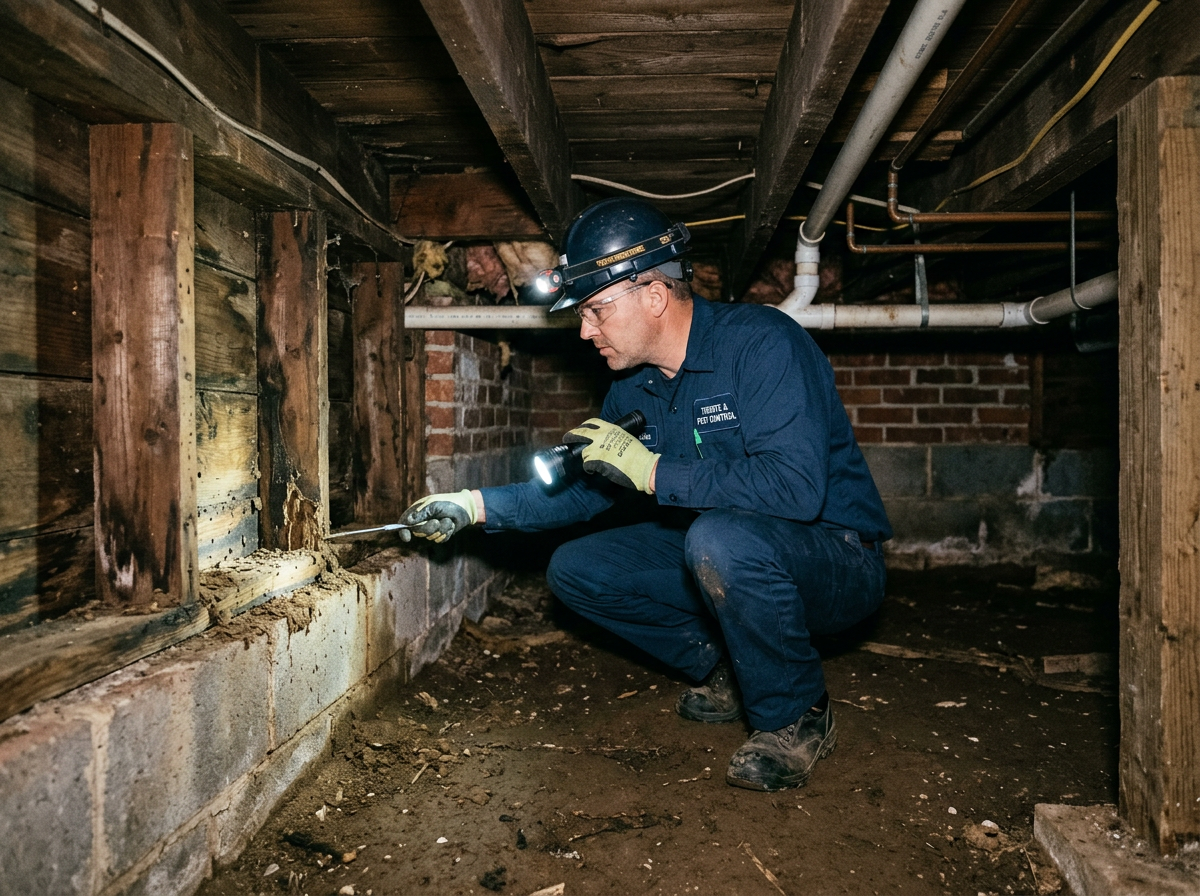
A termite inspection begins in the crawl space where technicians check piers, sill plates, and joists for mud tubes running from soil to wood. On the Eastern Shore high water tables keep soil damp under pier-and-beam homes, so tubes often appear along the coolest, most protected faces of the piers. The same inspection moves to any basement areas, looking for tubes on foundation walls and checking whether recent swarmers found indoors match the size and wing pattern of eastern subterranean termites rather than ants.
Outside, the perimeter walk checks the foundation line, mulch beds, and any railroad ties or deck posts touching soil. Easton homes frequently have additions poured later than the original structure, creating cold joints where termites cross untreated soil under the slab. Technicians also note grade levels that slope back toward the house and any irrigation heads spraying the foundation, both of which keep the soil barrier zone moist enough for foraging workers.
Termite Inspection Near You — Choose Your City
Every city below has its own local Termite Inspection page with coverage details.
St. Mary's County
Somerset County
Wicomico County
Talbot County
Queen Anne's County
Harford County
Prince George's County
Worcester County
Anne Arundel County
Calvert County
Charles County
Dorchester County
Frederick County
Kent County
Prince George's
Baltimore County
Somerset
Wicomico
Charles
Cecil
Howard County
Caroline County
Washington County
Montgomery County
Harford
Queen Anne's
The final step records moisture readings at multiple points and photographs any active or inactive tubes. Because a single visible tube rarely represents the whole colony, the report maps every location so the treatment plan can close the continuous barrier without gaps. Annual re-inspections catch new activity before it reaches living areas or triggers a failed real-estate WDI report.
Technician insight
In Easton the thing that catches most people out with Termite Inspection is how quickly a high water table under pier homes turns a small mulch bed into an active foraging corridor. Homeowners often seal one visible tube on the front porch while the colony keeps working from the back where the addition meets the original slab.
Crawl-space inspection on an older Easton home
The owners noticed small swarmers near a bathroom baseboard in spring. The technician entered the crawl space and found active tubes on three piers plus a cold joint under the 1980s addition. The report mapped every tube and noted the constant moisture from the nearby drainage ditch so treatment could close the barrier without leaving untreated gaps.
Termite Inspection Services We Offer
✓Crawl Space and Basement Inspection
Technicians enter crawl spaces and basements to inspect piers, joists, and foundation walls for mud tubes and moisture conditions that support eastern subterranean termites.
✓Exterior Perimeter Inspection
A full walk around the foundation checks soil-to-wood contact, mulch beds, and slab edges where termites commonly enter Maryland homes.
✓Moisture and Conducive Conditions Survey
Readings and observations identify areas where high water tables, poor drainage, or stacked landscaping materials keep soil damp enough for ongoing termite foraging.
✓Annual Re-Inspection
Scheduled yearly visits recheck previous tube locations and new construction additions to catch activity before it spreads inside the structure.
How it works
- 1
Schedule and Access Review
Confirm crawl-space access, basement entry, and any locked additions so the technician can reach every area on the first visit.
- 2
Interior and Crawl-Space Examination
Inspect all accessible wood members and foundation surfaces for active or inactive mud tubes and note any swarmers or discarded wings.
- 3
Exterior Perimeter Walk
Check the soil line, additions, and landscaping features that create entry points or moisture pockets around the entire structure.
- 4
Report and Recommendations
Compile findings with photos and map locations so any needed treatment can address the full foraging pattern without leaving gaps.
Pricing
Scope depends on square footage, number of additions, crawl-space access, and whether the inspection supports a real-estate transaction. Call to schedule and receive a quote based on the actual property.