
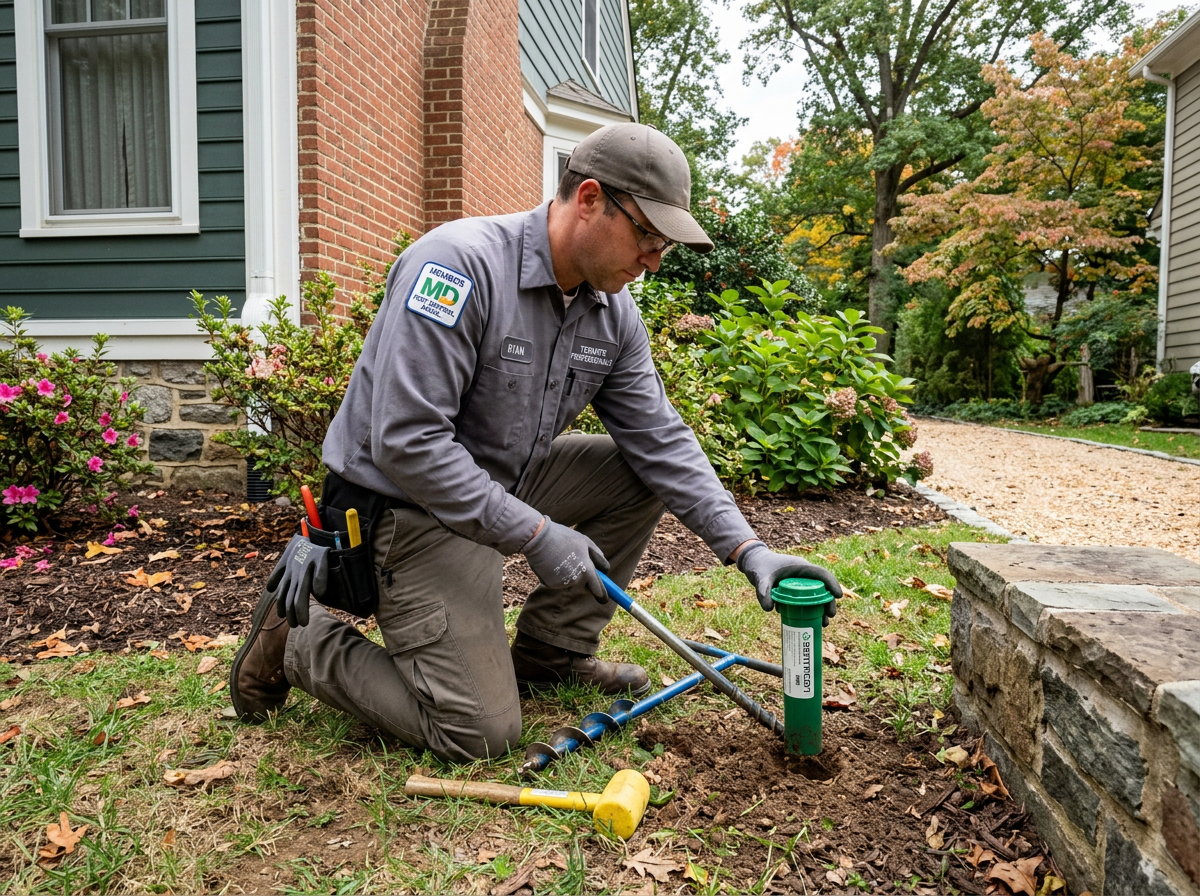
Eastern subterranean termites in Easton and across the Eastern Shore forage from colonies that can stretch 200 feet or more through the high water table and sandy loam soils. Homeowners usually notice spring swarmers inside or mud tubes along pier foundations and joists in crawl spaces rather than obvious structural damage. Baiting works by placing stations at intervals of roughly 10 to 20 feet around the perimeter and inside accessible crawl areas so foraging workers encounter the bait and carry it back to the colony.
Placement requires identifying active tubes and moist soil zones created by the Choptank River influence and frequent tidal flooding. Stations are driven or buried at grade so they stay accessible for quarterly checks; any gap larger than a few feet lets foragers bypass the system and re-enter through untreated soil under additions or porches. Because the method relies on colony feeding rather than an immediate kill, visible activity can continue for several months while the bait takes effect.
Termite Baiting Systems Near You — Choose Your City
Every city below has its own local Termite Baiting Systems page with coverage details.
St. Mary's County
Somerset County
Wicomico County
Talbot County
Queen Anne's County
Harford County
Prince George's County
Worcester County
Anne Arundel County
Calvert County
Charles County
Dorchester County
Frederick County
Kent County
Prince George's
Baltimore County
Somerset
Wicomico
Charles
Cecil
Howard County
Caroline County
Washington County
Montgomery County
Harford
Queen Anne's
The main trade-off is slower visible results compared with a continuous liquid barrier, yet baiting avoids trenching around mature landscaping and does not disturb the moisture that already keeps colonies active. Failures usually trace to stations that dry out, get covered by new mulch beds, or are spaced too far apart along railroad-tie retaining walls common on older watermen's properties. Regular monitoring visits catch these issues before a new swarm occurs.
Technician insight
In Easton the thing that catches most people out with Termite Baiting Systems is how quickly new mulch or tidal wash can bury or flood stations along the Choptank shoreline; if you let the beds creep back against the piers the colony simply works around the gaps.
Pier Home Near Locust Point
Swarmers appeared in a bathroom of a 1940s watermen's house on piers. Inspection showed active tubes under the crawl space and along the east foundation. Stations were installed around the full perimeter and in two interior bays. Follow-up visits confirmed feeding in several stations and no new tubes after the third quarter.
Termite Baiting Systems Services We Offer
✓Bait Station Installation
Stations are placed at consistent intervals around the foundation and in crawl spaces to intercept foraging termites on the way to the structure.
✓Scheduled Monitoring Visits
Technicians return on a set cadence to inspect stations, record activity, and adjust placement before new tubes appear on piers or joists.
✓Station Servicing and Replenishment
Bait is refreshed or replaced when stations show feeding so the colony continues to receive material without interruption.
✓Bait-to-Barrier Conversion
When homeowners prefer faster protection, stations can be supplemented or replaced with a liquid soil treatment while keeping some stations for ongoing monitoring.
✓Perimeter Defense Setup
Additional stations are installed along mulch beds, railroad ties, and other wood-to-soil contact points that keep colonies active near the house.
How it works
- 1
Site Assessment
Technician inspects crawl space, piers, foundation walls and exterior grade for active tubes and moisture conditions typical of Easton properties.
- 2
Station Layout
Stations are mapped at regular intervals around the perimeter and inside accessible areas, avoiding gaps near additions or porches.
- 3
Installation
Stations are placed at proper depth and angle so they remain accessible for monitoring even after seasonal ground movement.
- 4
Monitoring Schedule
Initial checks occur within 30 to 45 days, then every 60 to 90 days to track feeding and replenish bait as needed.
Pricing
Scope depends on home size, crawl space access and number of stations required; call for an inspection-based quote.