
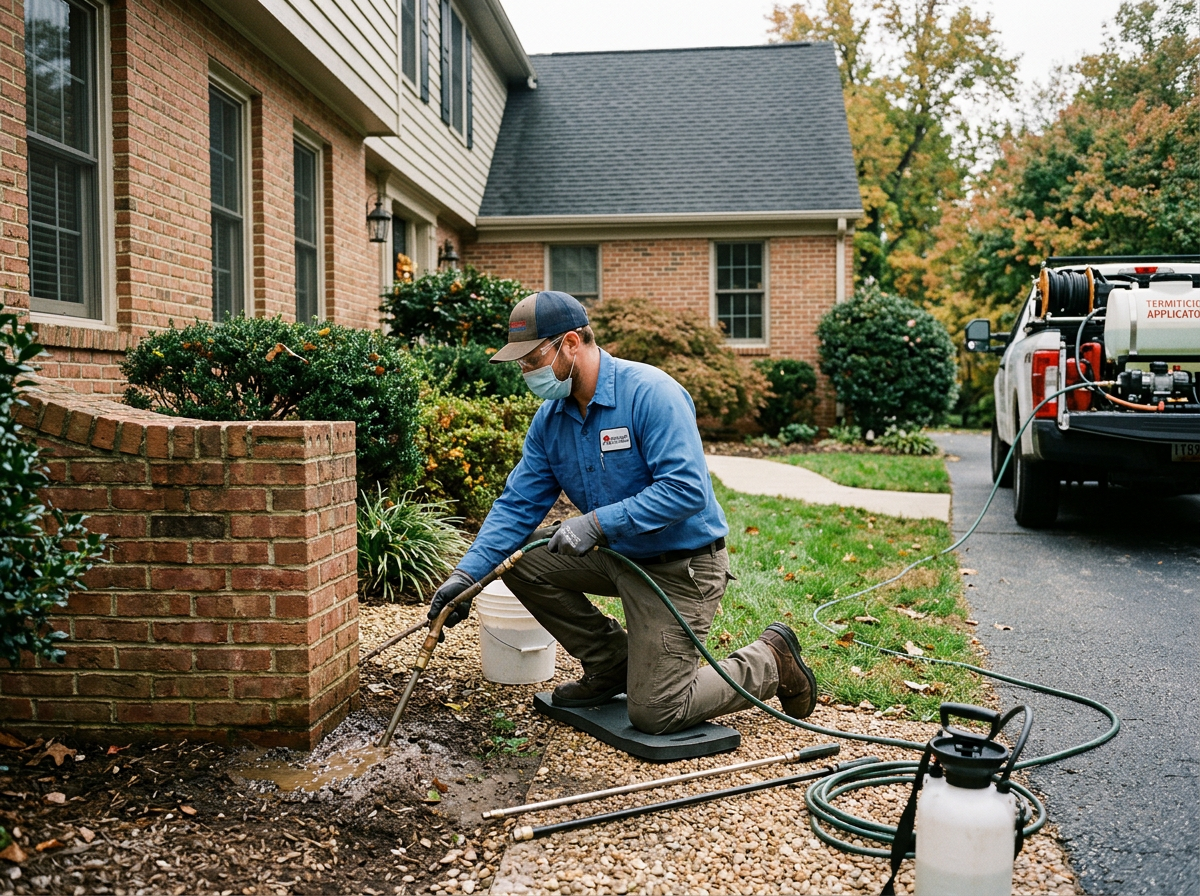
Work in Andrews Air Force Base centers on the Andrews AFB neighborhood where frame homes sit among mature trees and leaf litter that holds moisture against foundations.
Access follows MD-4 and MD-5 from the Eastern Shore, with seasonal patterns driven by the humid subtropical climate that keeps termite pressure active through mild winters.
Here's how our eastern subterranean termite control work runs in Andrews Air Force Base — the same standards we hold across Maryland, delivered by the crew that covers Prince George's.
Eastern Subterranean Termite Control Services We Offer in Andrews Air Force Base
✓Colony Assessment
Technicians trace mud tubes and foraging patterns to locate the main colony rather than treating isolated tubes that leave the source intact.
✓Conducive Conditions Correction
Addresses mulch beds, railroad ties, and wood-to-soil contact around Easton foundations that maintain the high moisture levels colonies require.
✓Exterior Perimeter Treatment
Creates a continuous liquid soil barrier through trenching and rodding to interrupt foraging routes before they reach the structure.
✓Annual Monitoring
Scheduled visits check for new activity, refresh bait stations, and verify barrier integrity on properties with persistent water-table moisture.
✓Crawl Space and Pier Treatment
Targets the soil beneath pier-supported homes where constant dampness allows colonies to maintain direct wood contact.
✓Slab and Addition Treatment
Rods beneath concrete slabs and home additions to close gaps where termites bypass the main perimeter barrier.
Eastern subterranean termites build colonies that can forage several hundred feet from the main nest, often remaining hidden until mud tubes appear on foundation walls, piers, or joists. In Easton homes, especially older watermen's properties elevated on piers over damp soil, spring swarmers inside frequently get mistaken for ants, prompting calls only after visible evidence surfaces. A single visible tube rarely indicates the full extent of activity because workers travel back to the central colony, leaving gaps in treatment that allow re-entry.
Effective control requires mapping active foraging routes rather than spot-treating tubes. Technicians trench and rod along the exterior perimeter, apply liquid termiticide to create a continuous soil barrier beneath slabs and additions, or install bait stations at intervals that intercept workers. Failures commonly occur when mulch beds or railroad ties remain against the foundation, or when additions create untreated soil pockets that break the barrier line, letting the colony re-establish.
How It Works in Andrews Air Force Base
- 1
Initial Site Walk
Technician examines exterior foundation, crawl space piers, and any visible mud tubes to identify active foraging paths.
- 2
Colony Mapping
Activity is traced to determine likely nest location and foraging distance so treatment reaches the full colony.
- 3
Barrier or Bait Placement
Liquid termiticide is applied via trench and rod or bait stations are installed at intervals along active routes.
- 4
Follow-Up Inspection
Return visit confirms no new tubes or station activity and adjusts placement where gaps appear.
Serving All of Andrews Air Force Base
We regularly handle eastern subterranean termite control jobs near:
- 📍Joint Base Andrews
- 📍Air Force One Pavilion
- 📍Andrews AFB neighborhood
Eastern Subterranean Termite Control Pricing in Andrews Air Force Base
Scope depends on structure size, crawl space access, and whether liquid barrier or bait stations are selected after inspection. Call for details.
Want the full picture of this service? See our Eastern Subterranean Termite Control page, or everything we do in Andrews Air Force Base, MD.